


Unified clinical workflows
Intake → documentation → follow-up in one experience. Less repetitive work, more focus on the patient.
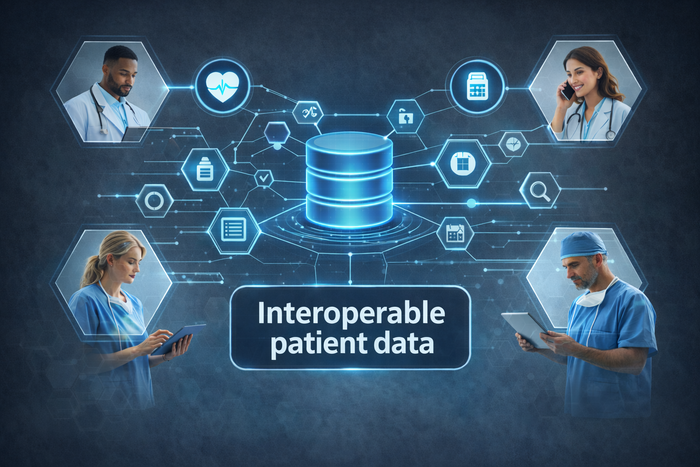
Interoperable patient data
Connect systems with FHIR/HL7-compatible APIs and improve data quality for safer decisions.

AI decision support in context
Risk signals, pathway guidance, and alerts inside the workflow — with human oversight by design.
What slows providers down — and creates burnout
Providers are under pressure to reduce costs and improve quality while dealing with fragmented data, complex reimbursement rules, and increasing compliance requirements.
Modern care cannot run on paper, silos, and manual handoffs
The eliminate-paperwork movement reflects what providers feel every day: legacy workflows slow care, fragmented systems break journeys, and decision support arrives too late.
- Legacy workflows + resistance to change
- Data fragmentation + limited interoperability
- Real-time decision-support gaps
- Patient engagement barriers and access equity

One unified platform for providers — and aligned insurers
Core capabilities
- AI triage, risk stratification, pathway guidance.
- Telemedicine with scheduling, billing, documentation, and remote monitoring.
- Longitudinal follow-up between visits and evidence.
- Governed data layer: consent, audit trails, role-based access.
- Interoperability: open APIs, FHIR/HL7 compatibility.
Provider benefits
- Productivity: AI-assisted documentation, templates, automated referrals.
- Coordination: faster transitions, tighter follow-ups.
- Outcomes: guideline adherence, proactive interventions.
- Revenue cycle: fewer denials, standardized coding.
- Telehealth encounters integrated into billing workflow.
Insurer benefits
- Cost control: predictive models signal high-cost trajectories.
- Utilization management: preauthorization workflows aligned with pathways.
- Engagement: preventive programs + personalized wellness.
- Value contracts: transparent performance tracking.
- Privacy: aggregated/de-identified analytics for underwriting and design.
A practical plan for adoption
ECAPLUS supports modular deployment: start with telemedicine and coordination, then expand into analytics and insurer alignment.
Open APIs, FHIR/HL7 compatibility, secure connectors to EHR, billing systems, and insurer platforms.
Regional/global doctor networks, multilingual support, after-hours access, remote-monitoring integrations.
Human oversight for critical decisions, transparent performance reporting, drift monitoring, bias audits.
Consent management, data minimization, encryption, access controls, incident response, retention policies.
Clinician and staff training, workflow redesign, stakeholder engagement, pilot programs, feedback loops.
Productivity, satisfaction, access metrics (wait times, after-hours use), claims trends, ROI.
Replace manual workflows with a modern, unified care platform
Reduce burnout. Improve coordination. Align providers and insurers with privacy-preserving analytics.